
Your needs, this model
Does it fit your priorities?
Is the Curve Ball's surface classified as smooth?
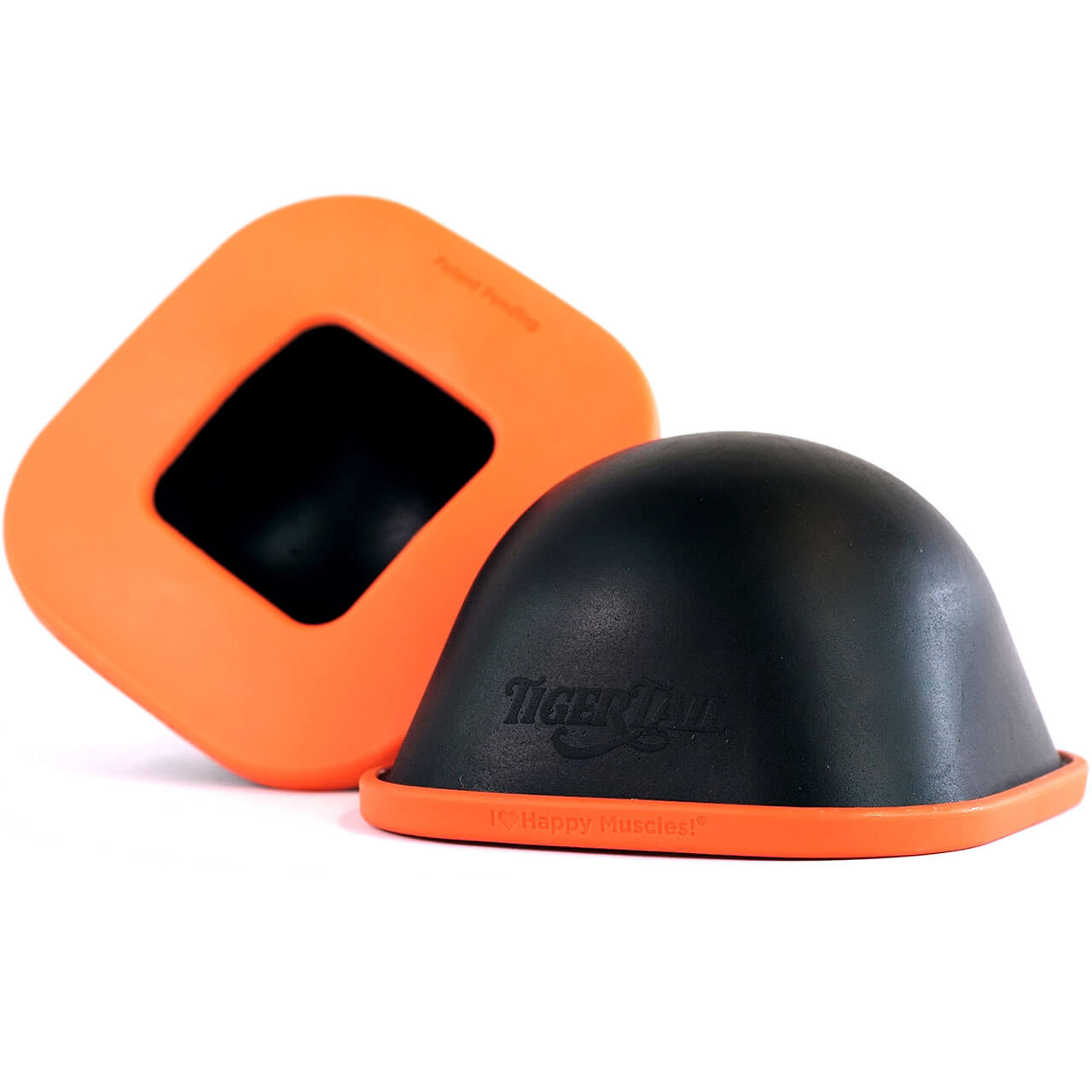
Tiger Tail describes a smooth curved surface, and the exact image shows no raised zones. The page does not quantify its friction or pressure.
Explore this need in the finder →Can the Curve Ball be compared by the finder’s roller-length bands?
No. The maker gives a 5.5 × 5.5-inch footprint and 3.25-inch height, not a longitudinal rolling length. It is kept out of compact/mid-size/long length matches.
Explore this need in the finder →Does the listing establish a hollow or solid core?
No. The exact page does not classify the internal construction, so neither hard-core choice is supported.
Explore this need in the finder →Assessment scope: this is a source-based review of Tiger Tail's current Curve Ball listing and exact product image, not a hands-on test. The manufacturer calls the item a stationary foam roller; in practical terms, the base remains put while the user shifts body weight across a curved contact head.
A stationary contact point, not a traveling cylinder
That difference is the Curve Ball's main reason to exist. A conventional cylindrical roller turns as you move over it, giving you a longer moving path. Tiger Tail describes this dome as staying in place, with a grippy flat orange base, so you can hold pressure at one spot or make a small controlled motion without chasing a rolling tool. The direct page lists use against a floor, chair, bed or wall. Those placements make the object more adaptable than a floor-only cylinder, but they do not turn it into a portable handheld wand: you still have to brace the base against a surface and control your own position.
The maker's suggested areas include hips, glutes, back, shoulders and psoas. Those are the manufacturer's use suggestions, not proof that every person or body area should be pressed in the same way. Its instructions lean on body weight as leverage, which makes gradual setup more sensible than forcing pressure. People dealing with an injury, a medical condition or pregnancy should take the manufacturer's advice to consult a clinician before massage therapy seriously.
What its dimensions do—and do not—tell you
The product Details section gives a 5.5 by 5.5-inch footprint and a 3.25-inch height, and lists weight at 7.6 ounces. Those figures help with storage and show that the contact point is a small, self-contained object. They are not a longitudinal rolling length. The finder therefore does not classify the Curve Ball as compact, mid-size or long, even though its footprint is small: those options are length bands for a roller axis, and the maker does not publish one for this stationary dome.
There is a second measurement issue worth keeping visible. Tiger Tail's short description says the rounded massage surface is approximately 4 inches across, while the Details section labels the massage surface as 5.5 inches. The page does not explain whether the figures refer to different parts or measurement conventions. I leave the conflict unresolved rather than choosing whichever number appears more convenient. If the exact contact diameter matters for your setup, confirm it with the maker before purchase.
Surface, material and core evidence
The maker describes the curved surface as smooth and says it glides over clothing; the supplied product photo shows an unraised, continuous black dome above the orange base. That supports a smooth-surface classification in the finder, but it does not tell us how slippery it feels, how much pressure a person will experience or whether it will suit a particular sensitivity. The company also calls the surface high-density and non-porous and says the firm ball does not flatten. No standardized firmness result, load limit or material chemistry is supplied. Likewise, visible shape and firmness wording do not establish a hollow or solid internal core, so the product will not appear when either core type is a hard requirement.
The one-year warranty is a useful stated term to compare, not an assurance about the quality or length of coverage for every seller. The page says the base is grippy and names wood floors and carpet in its feature text, but those are maker claims rather than independent traction tests. The review does not infer performance on wet, unstable or unusually soft surfaces.
Who should compare it—and who should look elsewhere
Compare the Curve Ball if you specifically want a stationary curved surface and a stable base that can be braced against different supports. The flat base and compact footprint are materially different from Tiger Tail's free-moving Tiger Ball sphere, the paired Peanut rollers and its full-width cylinders. The stationary dome favors a held contact point; a freely rolling sphere or cylinder favors movement along a longer track. If you need broad continuous coverage, a 15-, 24- or 36-inch cylinder gives a more relevant length specification. If you need a measured, repeatable pressure level or clear core construction, this page does not provide that evidence.
Before choosing, check the exact CBSRP listing, confirm the contradictory contact-surface measurement if it affects placement, and verify seller return terms and the current warranty. In short, the Curve Ball is an unusual, source-documented stationary tool rather than a small version of a standard roller. Its useful distinction is the fixed grippy base and curved dome; its limits are the ambiguous contact measurement, unknown internal construction and lack of an axial length figure.
Key specifications
Key details at a glance
| Listed product weight | 7.6 oz |
|---|---|
| Surface pattern | Smooth surface |
| Powered operation | No |
| Warranty | 1 year |
Use the exact model’s instructions for operating limits, supplied equipment and version differences.
Sources for this review
Sources for this assessment

Compare the tradeoff against your routine
Use the source-based finder to compare documented size, surface and construction preferences; it does not predict comfort or therapeutic outcomes.