
Your needs, this model
Does it fit your priorities?
Does the Beastie Bar use a smooth or raised surface?
The manufacturer describes two Beastie balls with high-profile textured bumps that spin freely on the shaft. The surface is raised/patterned, not smooth.
Explore this need in the finder →Does its 15-inch overall length qualify as compact roller length?
The product page lists 15 inches end to end, but this length belongs to the whole handled tool; its two separated 3-inch rolling balls are not a continuous roller cylinder. The length-class finder therefore leaves it unclassified.
Explore this need in the finder →Can the tool be matched as solid-core construction?
No. The source identifies a rigid fiberglass shaft and two rotating balls, but it does not state a solid/hollow core for a roller body. The finder does not reinterpret the handle as a solid foam-roller core.
Explore this need in the finder →This is a source-based assessment of the RumbleRoller Beastie Bar, not a hands-on review. The analysis uses the manufacturer's current U.S. product page and its exact variant record checked October 29, 2026. No personal use, pressure test, or measured performance claim is involved.
A handled pair of rolling contacts
The Beastie Bar places two high-profile Beastie balls on a rigid fiberglass shaft. The manufacturer says the balls are fixed along the bar but spin freely, so their textured surfaces roll across tissue instead of dragging. The company lists an overall end-to-end length of 15 inches and a three-inch diameter for each ball. These are dimensions of a two-contact tool, not a single 15-inch foam roller. The separated balls do not form a continuous cylinder, and the primary sources do not describe the tool as foam.
Unlike a full-size bodyweight roller, the bar can be driven by the hands. The manufacturer's copy says that this gives the user direct control over applied force and positions it for smaller contact zones such as calves, forearms, shins, and quads. These are the maker's intended-use descriptions, not independent tests or personalized exercise advice. The bar's point-focused contact pattern is more relevant than its overall length if you are comparing what kind of rolling action it offers.
Firmness and stands are separate choices
The product page offers Original and Xtra Firm contact balls. The manufacturer describes Original as firm but yielding and Xtra Firm as considerably harder, roughly comparable to a lacrosse ball; those are qualitative descriptions rather than scale readings. Its guidance also distinguishes how pressure is applied: the maker says Original suits floor work with body weight behind it, while Xtra Firm can be more approachable for lower-force wall or chair work. For this handheld bar, pressure comes chiefly from how the user holds and moves the handle. Do not treat “Xtra Firm” as a measured pressure value or as a clinical recommendation.
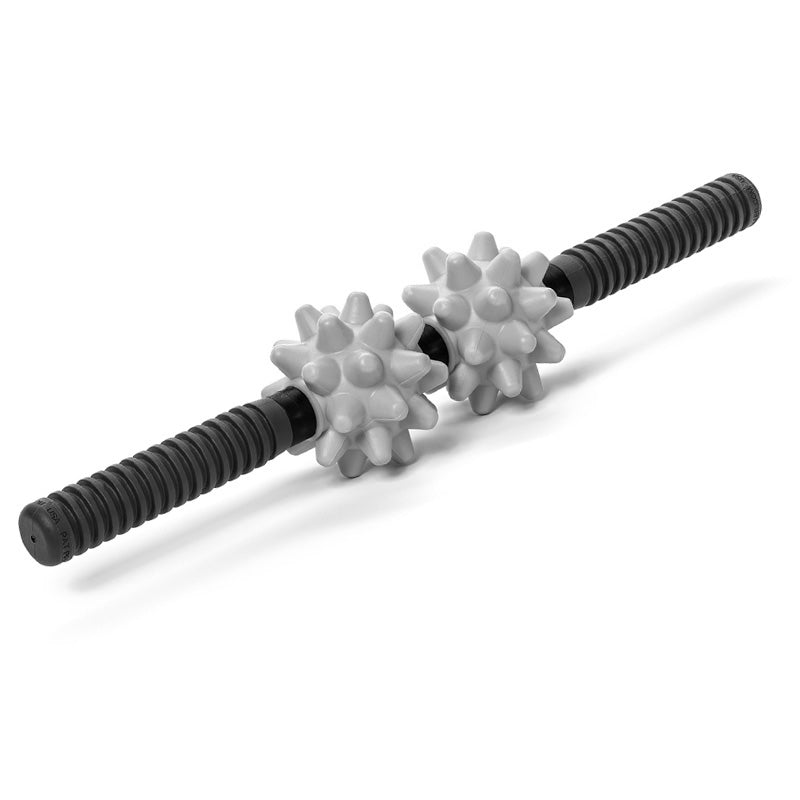
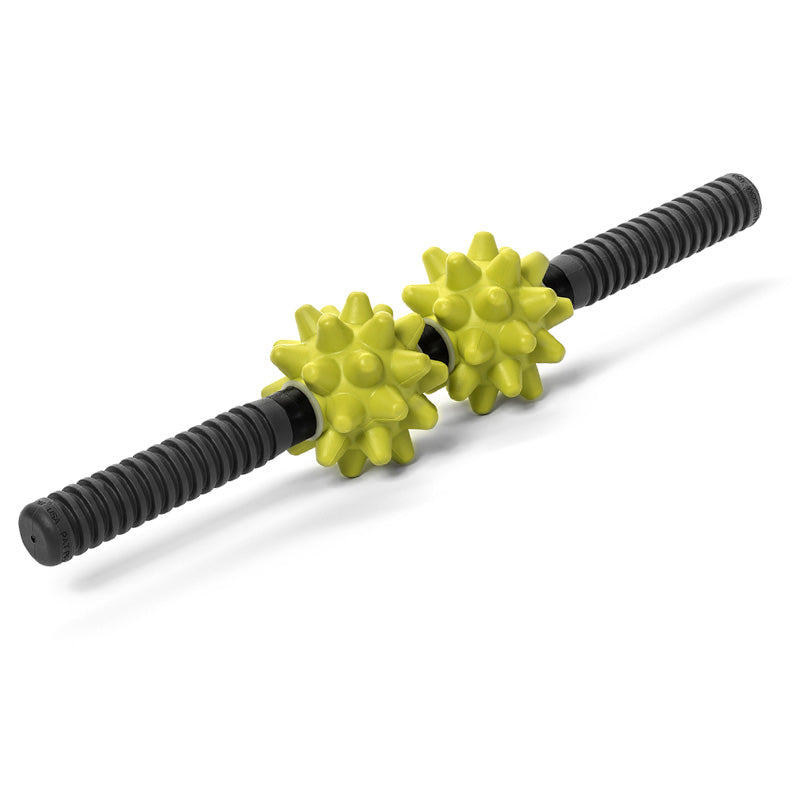
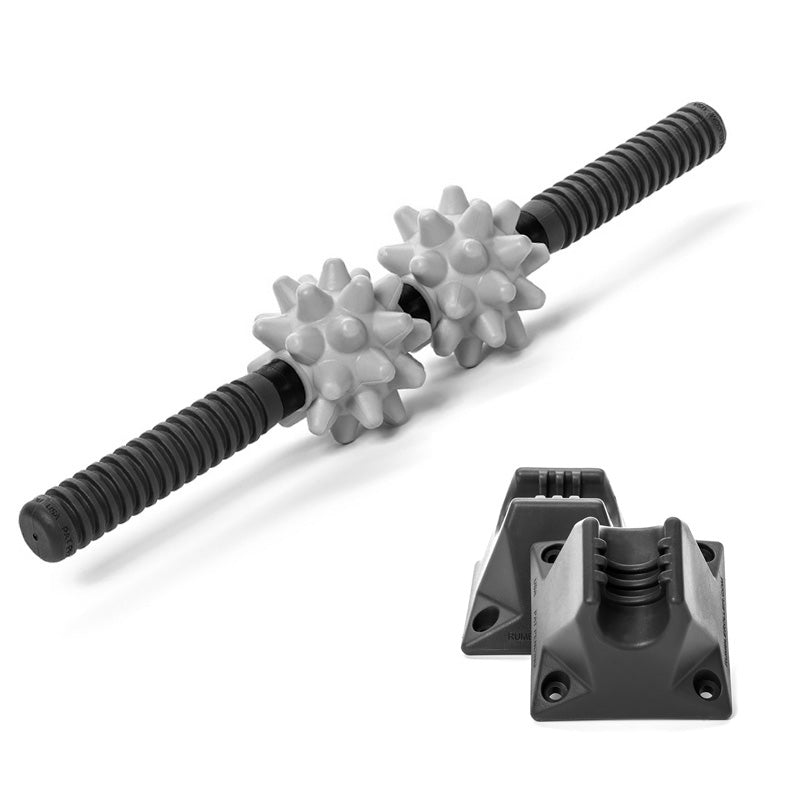
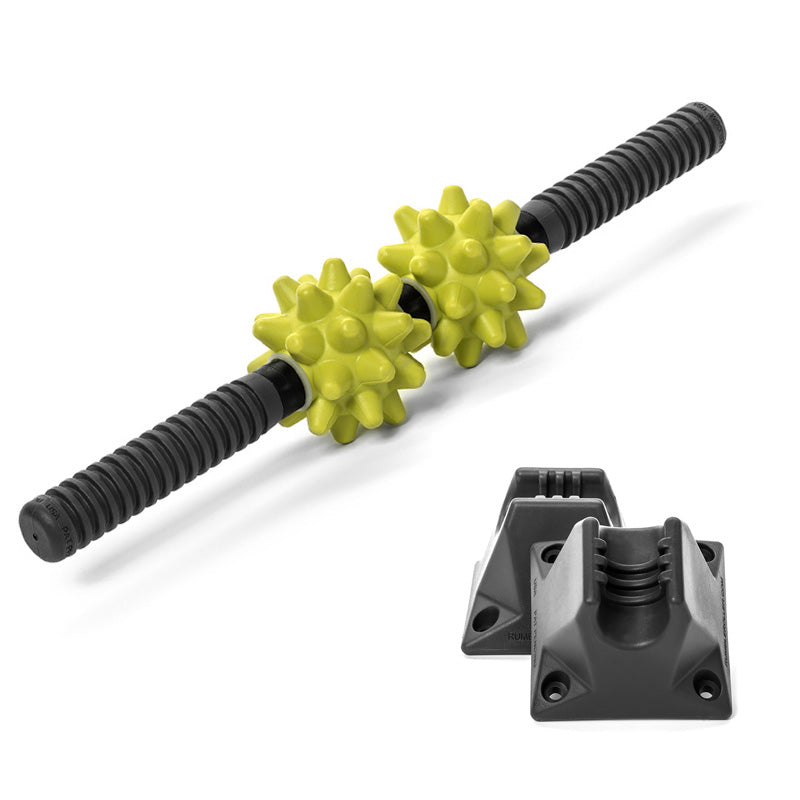
A second selector controls whether the package includes stands. Bar-only versions are held by hand. In the with-stands versions, the maker says the bar can sit on the floor as a supported tool, allowing a user to position over it. That changes the arrangement and how force is applied, so it is not merely a cosmetic bundle difference. The four captured SKUs are BRO - Beastie Grey (Original, bar only), BRX-Beastie (Xtra Firm, bar only), BROT2 - Beastie Grey (Original with stands), and BRXT2-Beastie (Xtra Firm with stands). Confirm both selectors in the actual offer.
Exact firmness and stand configurations
These page-linked manufacturer images show the four visible configurations. They document the parts pictured, not a load rating, standardized firmness, or hands-on result.
How it fits a length-and-format shortlist
The 15-inch figure is useful for storage and package comparison, but it is the bar's total end-to-end span. It is not a safe proxy for the length of a continuous roller surface. This guide therefore leaves the bar's `length_in` matcher field unknown: the quiz asks about a roller-length class, and a 15-inch handle with two spaced three-inch rolling balls does not document the same kind of length as a 12- or 22-inch foam cylinder. A compact finder result should not be used to imply identical working span.
Surface is different. The page documents high-profile bumps on both rotating balls, so the raised-or-patterned option is supported. The page does not identify a solid or hollow roller core for the tool. Although it calls the shaft fiberglass, that fact cannot be substituted for a core specification about a foam roller body.
Evidence limits and purchase checks
The manufacturer page identifies the shaft as fiberglass but does not specify the balls' material formulation, the stands' construction, a complete tool weight, or a standardized firmness measure. It provides no numerical load limit for the stand-supported arrangement. Verify which firmness and stand option the seller is offering, and check that the exact SKU and package match the setup you intend to use. The brand's page states “Made in the USA”; that statement has not been independently verified here.
A bounded CPSC product-name query returned an empty XML record set on the date captured. That result is limited to the searched name and time; it is not a guarantee that the product has no recall or safety notice under another identifier or later date. Use the manufacturer's current instructions for any setup and do not infer a use limit from an image or from the shaft's material.
Bottom line
The Beastie Bar is a distinct manual rolling format for shoppers comparing a handled pair of textured rolling contacts. Its meaningful configuration choice is not just Original versus Xtra Firm: the with-stands package creates a floor-supported arrangement that the bar-only package does not supply. It is not a replacement for a continuous foam cylinder when uninterrupted span, a specific roller length, or a known core construction is essential. Confirm the exact firmness, stand inclusion, and SKU before purchase.
Key specifications
Key details at a glance
| Surface pattern | High-profile nodules |
|---|---|
| Overall tool length (not continuous roller span) | 15 in |
| Beastie rolling-ball diameter | 3 in |
| Powered operation | No |
Use the exact model’s instructions for operating limits, supplied equipment and version differences.
Sources for this review
Sources for this assessment
Compare the tradeoff against your routine
Use the source-based finder to compare documented size, surface and construction preferences; it does not predict comfort or therapeutic outcomes.