
Your needs, this model
Does it fit your priorities?
Does Trackball Firm meet the compact length choice?
No confirmed length can be assigned. The reviewed U.S. product page publishes no overall dimension, and the image has no scale; the tool cannot be confirmed in any roller-length class.
Explore this need in the finder →Why is Trackball Firm grouped with patterned surfaces?
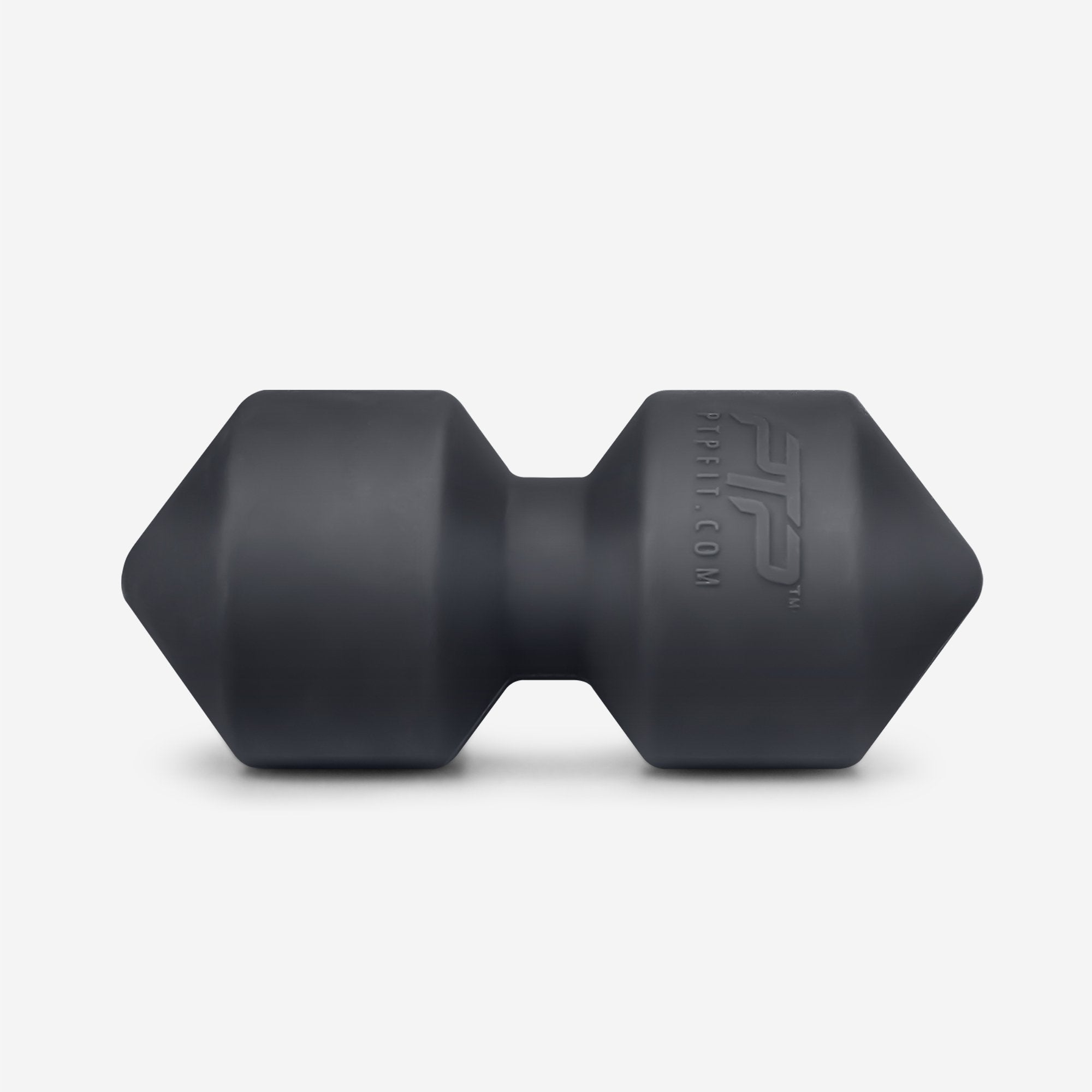
The exact product image shows a sculpted two-lobe form and recessed center. That supports a raised/patterned design classification, but it does not establish roughness, friction, pressure or how the surface feels.
Explore this need in the finder →Does the silicone body establish a solid roller core?
No. PTP identifies silicone as the material but does not describe the internal construction as hollow or solid, so a hard core request is not met by the available evidence.
Explore this need in the finder →PTP’s current U.S. listing identifies this model as TRACKBALL FIRM, SKU TB FIRM. It is a single connected, two-lobed silicone tool with a recessed center, rather than a long foam cylinder or two separate massage balls. The maker says to roll it up and down the spine while lying down or standing against a wall, and describes the recess as accommodating the spinal bones. That spine-oriented shape is the most useful fact for comparing it with other manual rollers; it is not evidence of a health outcome or a substitute for individualized guidance.
A track shape, not a full-width cylinder
The central notch and paired rounded lobes make this a specific-format tool. PTP positions it for back and neck use and describes a rolling path along the spine. A conventional full-size cylinder presents a continuous broad rolling span; the Track Ball instead has two separated contact lobes with a shaped gap between them. That structural difference helps explain why someone seeking a spine-oriented track format might consider it, while someone wanting a broad, uninterrupted surface for rolling across larger areas may prefer a cylinder. This is a comparison of shape and maker-described use, not a claim that either format produces a better result.
The exact manufacturer image supports the connected twin-lobe outline and recessed midsection. It does not provide scale, and the reviewed U.S. product page publishes no overall length, width, diameter, or active rolling span. The product therefore cannot be placed in the site’s compact, mid-size, or long length classes. A small-looking photo is not a measurement, and the word “Trackball” does not establish a size.
What the firm label can tell you
PTP describes the offer as firm and says it is intended for shoppers wanting higher intensity. Those are the maker’s qualitative labels, not a numeric hardness rating. The page does not provide a durometer value, compression result, comparison scale, or documented test that would let a buyer place this silicone tool precisely against another brand’s firm foam roller. Treat the description as a product identifier and preference cue, not a prediction of how much pressure it will create or whether it will feel comfortable for a particular person.
PTP calls the material medical-grade silicone. The listing does not identify the precise compound, certification, or independent material test, so that phrase remains attributed to the manufacturer. No hollow-versus-solid roller-core description is published. Silicone material alone does not resolve how the interior is constructed, and neither hard core choice is treated as confirmed in the finder.
Surface classification is about visible form
The page-linked image shows sculpted lobes, a recessed waist, and a molded logo rather than a simple uninterrupted cylinder. For this site’s surface comparison, the contoured two-lobe layout is grouped with raised or patterned designs as “sculpted contours.” That is a visual design classification: the photograph cannot establish roughness, grip, friction, pressure, or tactile feel. The model can therefore match a surface-only patterned preference without implying that its material is abrasive or that its shape suits every body area.
This differs from PTP’s Massage Balls Combo and Trigger Balls Combo, each sold as a pair of separate soft- and firm-labelled spheres. The Sensory Ball is a single ball with visible projecting points. The Track Ball’s defining visual feature is the joined, recessed shape, not a set of spikes or separate loose balls. Those are distinct product forms even though the listings appear in PTP’s massage collection.
What remains unverified
The reviewed listing does not state a length or diameter, classify an internal core, give a load limit, or supply a standardized firmness measurement. It also does not specify detailed cleaning instructions or name an additional accessory. Those omissions matter if the purchase depends on storage dimensions, a measured firmness threshold, a verified core type, or a particular care routine. Ask the seller or consult the current instructions for the exact SKU rather than infer these details from the product photo or from a neighboring PTP model.
The U.S. page describes manual rolling against the back and neck, with the user lying down or standing at a wall. That supports a non-powered use plan; no motor, battery, charging requirement, or vibration setting is documented for this SKU. The product page also makes a claim about spinal-joint range of motion. This review does not treat that claim as independently established, and the product assessment is not medical advice.
Who may want it—and who should keep looking
This is a plausible shortlist candidate for someone looking specifically for PTP’s firm-labelled, manually rolled Track Ball form, particularly the maker-described central recess and paired lobes. Its clear advantage over an ordinary cylinder is a distinctive shape intended to travel along the back and neck; its tradeoff is that the available documentation does not establish dimensions, full-body coverage, or a comparable firmness value. If a known overall length or a documented hollow or solid construction is essential, the current evidence does not support a match.
Before ordering, check that the exact offer is TRACKBALL FIRM, SKU TB FIRM, rather than a vibrating track ball or another PTP massage product. Confirm the included configuration and the current manufacturer instructions, care guidance, seller terms, and return conditions. The review is based on the current U.S. manufacturer page, its single-variant product record, and the page-linked image; no hands-on use, ownership, comfort test, pressure measurement, or therapeutic result is claimed.
Key specifications
Key details at a glance
| Surface pattern | Molded contoured surface |
|---|---|
| Outer material | Ptp describes the material as medical-grade silicone; exact formulation, certification and material testing are not supplied in the reviewed listing. |
| Powered operation | No |
Use the exact model’s instructions for operating limits, supplied equipment and version differences.
Sources for this review
Sources for this assessment

Compare the tradeoff against your routine
Use the source-based finder to compare documented size, surface and construction preferences; it does not predict comfort or therapeutic outcomes.