
Your needs, this model
Does it fit your priorities?
Does the Flex Half-Round 36 x 3-in qualify as long?
Yes. The exact U.S. variant is 36 inches along its long axis, above the finder’s 26-inch long threshold. Its 3-inch depth describes the half-round shape, not a cylinder diameter.
Explore this need in the finder →How is the Flex Half-Round surface categorized?
The exact product-data tag and ProsourceFit comparison table call the family Smooth. That category is not a measurement of tactile feel; the curved face is not described as having a designed grid, node or ridge pattern.
Explore this need in the finder →Is the Flex Half-Round core confirmed solid?
No. The product page discusses foam material but does not state hollow or solid internal construction. Its EPE-versus-EVA material conflict also cannot answer a core question.
Explore this need in the finder →Configuration and dimensions
This review covers the 36 x 3-inch ProsourceFit Flex Half-Round Foam Roller, variant 15033215235 and SKU ps-2111-foam-36x3. The exact manufacturer page gives the dimensions as 36 inches high by 6 inches wide by 3 inches deep. It is a half-round with a flat side and a curved side, not the brand's full cylindrical Flex roller. The 36-inch length is the long class in the site's finder; the family also has a separately identified 12 x 3-inch compact version.
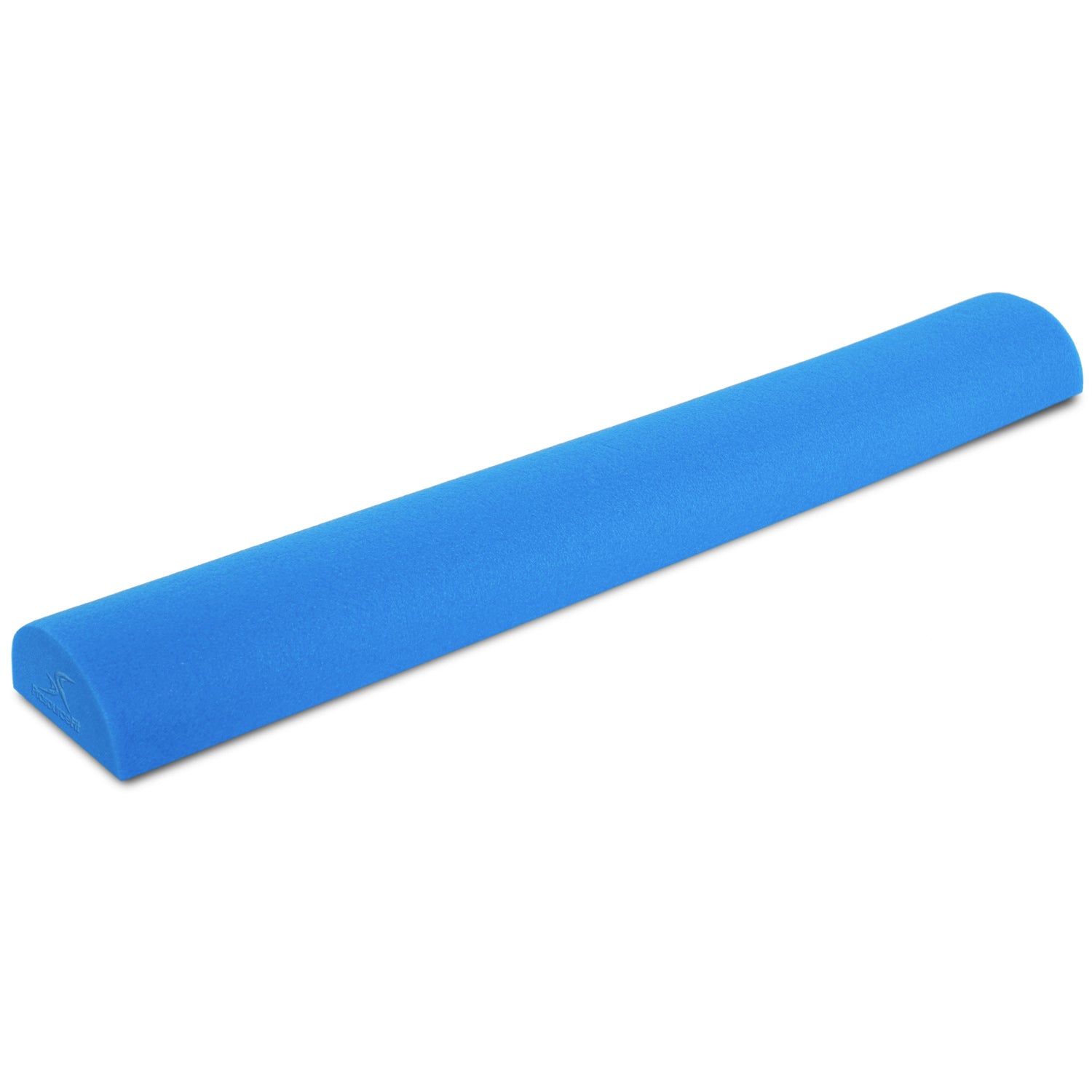
That distinction affects what the size means. The 36-inch unit provides a longer continuous axis than its 12-inch sibling, but the published 3-inch depth is part of the half-round profile. It should not be compared with a six-inch cylinder as if the outside geometry were the same. The exact photo helps identify the blue foam shape; size comes from the maker's specification and variant label, not visual scale.
How ProsourceFit says to use the profile
The page explains that the flat face can rest down to start with a more stable setup and the rounded face can be turned down for more challenge. It describes the half-round for balance, core stabilization and light stretching. Those are the manufacturer's use descriptions, not independent demonstrations that a particular person will gain stability or flexibility. No hands-on evaluation is claimed here.
A buyer should decide whether that supported flat/rounded format fits the intended exercise or floor placement. It is not a substitute for a full cylindrical roller if the desired motion requires a round continuous surface. ProsourceFit calls the product lightweight and easy to carry, but the reviewed public page does not give a unit-labelled weight for this exact child. The long size also takes more uninterrupted floor or storage length than the 12-inch version; that is a dimensional comparison, not a performance recommendation.
A material discrepancy worth keeping visible
There is a first-party disagreement in the material description. The current Flex Half-Round product page says the roller is made from EPE foam. ProsourceFit's own foam-roller comparison table lists the Flex Half-Round as EVA foam. The table also describes the family as low density, while the exact page calls the foam firm and describes a soft, unstable surface. The evidence does not resolve whether the table is outdated, uses a different classification, or reflects a product change, so this assessment does not assign a confirmed polymer.
Those words also do not form a standardized firmness scale. “Firm,” “soft,” “low density” and “unstable” are qualitative manufacturer language. There is no durometer number, compression test or independent comparison with the High Density Half-Round's EPP description. A shopper who specifically needs EPE or EVA should confirm the current exact SKU with the maker before purchase, rather than relying on a family nickname or image.
Surface, core and care
The exact product-data record and ProsourceFit's comparison table classify the Flex Half-Round surface as Smooth. The blue selected image shows a uniform curved face, not a deliberately molded row of nodes, ridges, waves or a GRID pattern. Here the finder uses the maker's Smooth category to mean no documented raised contact design; it is not a claim that the foam will feel polished or have no grip.
Neither the page nor the product-data record says that the interior is hollow or solid. A material claim—even if it were consistent—would not establish the core. The maker publishes no standardized firmness result, consumer weight or rated load limit for this configuration. Its care wording is to clean with a disinfecting wipe or a wet cloth with mild dishwashing or laundry detergent. Check the directions that accompany the exact product; cleaning or durability was not tested for this review.
How it compares with the other half-round
The Flex Half-Round is distinct from ProsourceFit's High Density Half-Round: both have flat and curved faces and a Smooth table category, but the High Density family is consistently described as EPP in the reviewed page and selection chart. The Flex Half-Round's EPE/EVA mismatch prevents a clean material comparison, and the maker supplies no common hardness value for either design. Both are presented for balance and stretching tasks; neither description establishes a medical effect.
Within Flex Half-Round, choose the 12-inch variant when a compact length is essential, and compare this 36-inch variant when the long band is required. Before buying, confirm the exact 36 x 3-inch option, SKU, package contents, current material information and seller terms. If a known interior, measured firmness or rated load is a hard condition, this published record does not answer it.
Primary evidence checked 2026-11-02: the exact ProsourceFit 36 x 3-in variant page, the first-party variant record, and the maker's comparison table. The page/table composition conflict is retained, not silently resolved.
Key specifications
Key details at a glance
| Length | 36 in |
|---|---|
| Length class | Long class (26 in or more) |
| Surface pattern | Smooth surface |
| Powered operation | No |
Use the exact model’s instructions for operating limits, supplied equipment and version differences.
Sources for this review
Sources for this assessment

Compare the tradeoff against your routine
Use the source-based finder to compare documented size, surface and construction preferences; it does not predict comfort or therapeutic outcomes.